
The Wealth Transfer Starts With Us

Echo to Athena Journal
London. Texas. Online. The money is moving. Here is what each room can do this month.
The headlines treat the Great Wealth Transfer as a future event that will happen to the next generation. It is already happening at the table you sit at this week.
Cerulli Associates estimates $124 trillion will move in the United States through 2048. Before much of that capital reaches children, $54 trillion is expected to move sideways — spouse to spouse — and more than 95 percent of those surviving partners will be women. McKinsey puts women on a path toward $34 trillion in investable assets by 2030. A Citizens survey found 84 percent of women still say they lack confidence managing an inheritance.
That is not a branding problem. It is a governance problem. The first question is not what the heirs will do someday. It is who holds the pen now, in this city, under this law.
This season the book sat in three rooms that do not share a tax code. London is rewriting how family businesses pass. Texas is moving operating companies and family offices without a state inheritance tax — and still losing families in the handoff. The virtual room is where a woman who cannot fly to either city begins the same practice.
Same book. Different warehouse. Different homework.
London — the family firm no longer passes tax-free just because it is a family firm
Inheritance tax in the United Kingdom is a tax on what someone leaves when they die. The standard rate is 40 percent. For more than thirty years, a family that owned a real trading company or qualifying farmland could often pass that asset on without that 40 percent bill. HMRC called the shields agricultural property relief and business property relief. From 6 April 2026, those shields still exist. They are no longer bottomless.
HMRC’s policy paper, updated 3 March 2026, is the source of record. On 23 December 2025 the government raised the full-relief slice from the original £1 million proposal to £2.5 million per person. That is the number in force now.
In ordinary language:
The first £2.5 million of qualifying farm and business value, per person, can still pass at 0 percent tax.
Everything above that slice only gets half relief. Half off 40 percent is 20 percent tax on the extra.
A spouse or civil partner can inherit the unused slice. Two people, two pots: up to £5 million of qualifying farm and business assets can still pass at the full shield — on top of the ordinary nil-rate bands. HMRC’s worked combined figure, with those other bands, is up to £5.65 million between two people.
If you live together and are not married and not in a civil partnership, you do not get the second pot.
New trusts do not each get a fresh £2.5 million. They share one allowance.
Shares traded on markets HMRC treats as “not listed” — including many AIM holdings — only get the 50 percent rate. They do not sit in the generous private-company bucket.
A picture. One owner. A trading company worth £8 million that still qualifies.
First £2.5 million: no inheritance tax on that slice.
Remaining £5.5 million: 20 percent — about £1.1 million due, unless other reliefs apply.
That bill can be paid in ten equal yearly instalments, interest-free, on qualifying property. It is still a bill the next steward has to fund.
GOV.UK is plain about what does not count. A company that mainly holds shares, land as an investment, or other investments does not get this shield. You must have owned the qualifying asset for at least two years. Leaving everything to a spouse or civil partner is still usually tax-free on the first death. The new invoice tends to arrive on the second death — which is exactly when many women are asked to become the principal overnight.
That is the London conversation this autumn. Not whether wealth will move. It will. The question is whether the family company was planned under last year’s unlimited shield, or under this year’s priced one.
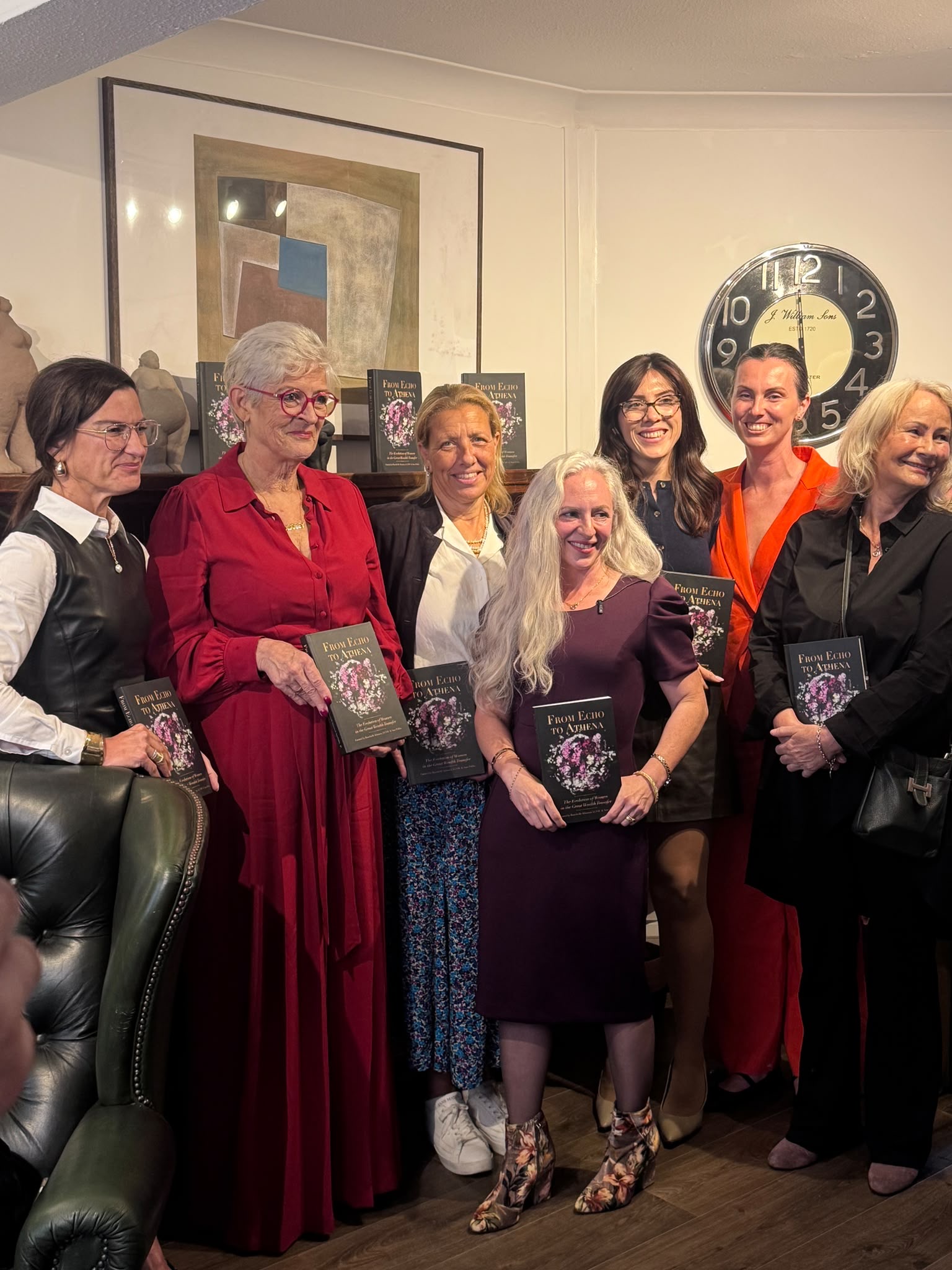
In London, curator Ruschelle Khanna, LCSW, gathered with Ann Priftis, Jane Evans, Kedge Martin, Dominnique Karetsos, Sasha Lund, Jessica McGawley, Deborah Delaney, and Monica Clare. They were honored. They were valued. It was a private gathering, not a public launch floor.
The vision does not close when the photographs do. It continues with the women already on the journey, guiding others to find community within as they move from Echo to Athena.
The work those voices already carry is public even when the night was not: Ann as co-curator; Jane’s Foreword; Kedge and the Labyrinth; Dominnique and Permission from the Gods; Sasha and Artemis; Jessica and Medusa’s Origins; Deborah and the body that can hold authority; Monica and the Goddess Constellation. A chorus, not a guest list.
What to do if your capital sits in the UK or will be taxed there
- Ask, in writing, whether the family trading company still qualifies as a trading business — not an investment wrapper. Relief dies if the company mainly holds shares, land, or investments.
- Map ownership against the £2.5 million allowance per person. If the business is larger, name who holds what before the second death, not after.
- If you are a spouse or civil partner, confirm the unused allowance can actually move to you. If you are not married and not in a civil partnership, do not plan as if it will.
- Buy the book on Amazon.co.uk. The US page will not ship print to most European addresses. Same title. Different warehouse.
- Open the workbook at fromechotoathena.com/workbook and write the afterword you would want the next steward to read — before the solicitor meeting, not after the grant of probate.
Texas — the tax is not the only handoff
Texas has no state inheritance tax and no state estate tax. Families still lose the company in the transfer.

The money in motion is not a slogan. D CEO, in May 2025, working from the then-standard national figures, put $84.4 trillion moving to younger generations through 2045 — and said half of that, $42.2 trillion, sits inside small and mid-sized businesses. Cerulli later raised the whole-household number to $124 trillion through 2048. Either way, a huge share of what will move is not a brokerage account. It is an operating company.
North Texas is already inside that handoff. The same D CEO piece placed Dallas–Fort Worth at the front of the wave: founders timing exits, private equity raising faster than it can deploy, and wealth leaving the family more often than in earlier generations — into family offices, funds, and buyers who are not kin. The Dallas Morning News, in July 2026, using FINTRX, counted 137 family offices in Dallas–Fort Worth and 248 in Texas out of 2,387 it could identify nationwide. Praxis Rock Advisors told the News that roughly 190 Dallas-area offices deployed $19.2 billion in 2024. Succession, the paper wrote, is a top concern as ranches, operating companies, and inherited real estate change hands.
Nationally, most of those companies are not ready. The Exit Planning Institute’s State of Owner Readiness work found about three in four owners want to exit within ten years, with on the order of $14 trillion of privately held business value in that window — and only 20 to 30 percent of businesses that go to market actually sell. A February 2026 McKinsey Institute for Economic Mobility estimate put as many as six million small and mid-sized firms facing an ownership change by 2035, representing up to $5 trillion in enterprise value, with a warning that a large share will close rather than transfer. Deloitte’s 2026 family-business survey: 85 percent say a plan matters; only 23 percent are actually running one. Harvard Business Review, in September 2025: more than half of U.S. employer businesses have an owner over 55 — about 2.9 million firms, $6.5 trillion in revenue.
That is the Texas problem in one line. The state will not take an estate-tax cut. Private equity will. A professionalized family office will. Or the company will simply stop. The next generation cannot refuse a bid they were never shown, and they cannot run a firm whose minutes still live in someone else’s voice.
On 16 September in Dallas, Danielle Patterson (Chapter 14, Athena the Shapeshifter) moderated From Wealth Creator to Capital Steward: Claiming Agency in the Next Chapter for JABOY Productions, with Thomasina H. Williams (Chapter 7, Nike’s Descent) on the panel. The question in that room was not whether Texas is “business friendly.” It was what happens when a woman is asked to become the steward of an operating company, a mineral interest, a family office, or a foundation — and the minutes, the voting rights, and the story of the firm still live in someone else’s voice.
What to do if your capital sits in Texas or another US family-enterprise room
- Separate three documents that families keep in one drawer: the will, the operating agreement or company bylaws, and the unwritten “how we do things.” The third one is where most transfers break.
- Put the surviving spouse and the rising generation in the same meeting with the advisor before a death or a sale. Firms that only knew the founder do not keep the assets when the founder is gone.
- If you are the woman being asked to “just sign,” ask for the cap table, the distribution schedule, and who can call a meeting. Authority that cannot see the books is not authority.
- Buy the book on Amazon.com if the ship-to address is in the United States.
- Use the workbook as the family memo you have not written: what must continue, what may be sold, what the next steward is not required to become.
The virtual room — practice without a passport
On 15 September the first livestream, From the Page to the Room, sat on LinkedIn Top Voices Unite Live. Nikki Estes hosted Jane Evans, Dr Stacy Feiner (Chapter 10, Hera), Kate MacGowan (Chapter 16, Athena’s Evolution), and dr. akasha (Chapter 9, Gaia and Uranus). The series title is the instruction: the chapter is not finished when it is printed. It is finished when it can be spoken in a room that is not the author’s.
If you were in Seoul or Seattle or a kitchen at 7:00 AM Eastern, that was your launch week. You do not need a photograph on a London ledge to be in the transfer.
Watch the replay: https://youtu.be/0Tblqrf2Jf4
What to do from wherever you are
- Watch the replay. One sitting. Notice which chapter names the decision you have been postponing. https://youtu.be/0Tblqrf2Jf4
- Choose your Amazon door by warehouse, not by habit. United Kingdom and Europe use amazon.co.uk. The United States and addresses Amazon.com will actually ship use amazon.com. Do not send a London reader to the US link and then wonder why the review never posts.
- Get the workbook — first name and email — and complete one chapter prompt this week. The public promise on that form is Write Your Afterword. https://fromechotoathena.com/workbook
- If you advise families, book the conversation that names both spouses and at least one rising-generation voice. If you are the woman at the table, ask for that meeting yourself.
- If the work is larger than a book — advisory teams, a keynote, the Write Yourself In retreat — begin that conversation on the site. Do not wait for the next city photograph.
How we step into governance
Holding the pen changes three things, in every jurisdiction.
Time. Liquidity, care, and philanthropy have to outlast one founder’s calendar.
Authority. A seat is not an opinion. It is the right to set the agenda and to see the books.
Language. Wealth is continuity, care, fairness, and risk — not only a balance sheet.
We do not walk this path as one city. London is pricing the family company again. Texas is deciding whether the operating business stays a family. The virtual room is where the rest of us stop echoing the last meeting and write the next one.
May the woman who enters this work leave more fully herself.
Get the book. Same title. Two warehouses.
Get the book — United Kingdom and Europe
Get the book — United States and elsewhere
If you are ordering from the United Kingdom or Europe, use the UK button. The US page will not ship print to most European addresses.
YouTube replay: https://youtu.be/0Tblqrf2Jf4
Notes
This essay is not legal, tax, or investment advice. Read the primary sources and take their numbers to your own counsel.
United Kingdom
- HMRC, “Agricultural property relief and business property relief changes,” updated 3 March 2026. gov.uk
- GOV.UK, “Inheritance tax reliefs threshold to rise to £2.5m for farmers and businesses,” 23 December 2025. gov.uk
- GOV.UK, “Business Relief for Inheritance Tax.” gov.uk
- GOV.UK, “How Inheritance Tax works: thresholds, rules and allowances.” gov.uk
Some bonus content
Hey there! Just sharing some thoughts, fun insights, and cool stories from my photography adventures. Come check out my creative process and what I've been working on lately!