
We’re Not Playing by the Rules Anymore: 5 Unspoken Truths About Power, Patriarchy, and Redesigning the System
Key takeaways
- The playbook is informal. 31% of entry-level women have a sponsor, compared with 45% of entry-level men [LeanIn.Org and McKinsey, 2025].
- Emotion is judged differently. Women who expressed anger at work were given lower status than men who did the same [Brescoll and Uhlmann, 2008].
- Gatekeeping is learned. Women who gain power can end up guarding the old rules. Sharing networks interrupts it.
- Care is strategy. The Sixth Level names mutuality, ingenuity, justness and intrinsic motivation as core leadership differentiators [Feiner et al., 2024].
- Money is a door. Beyond staying or leaving, where your capital sits is a form of agency. This is education, not financial advice.
Echo to Athena Journal
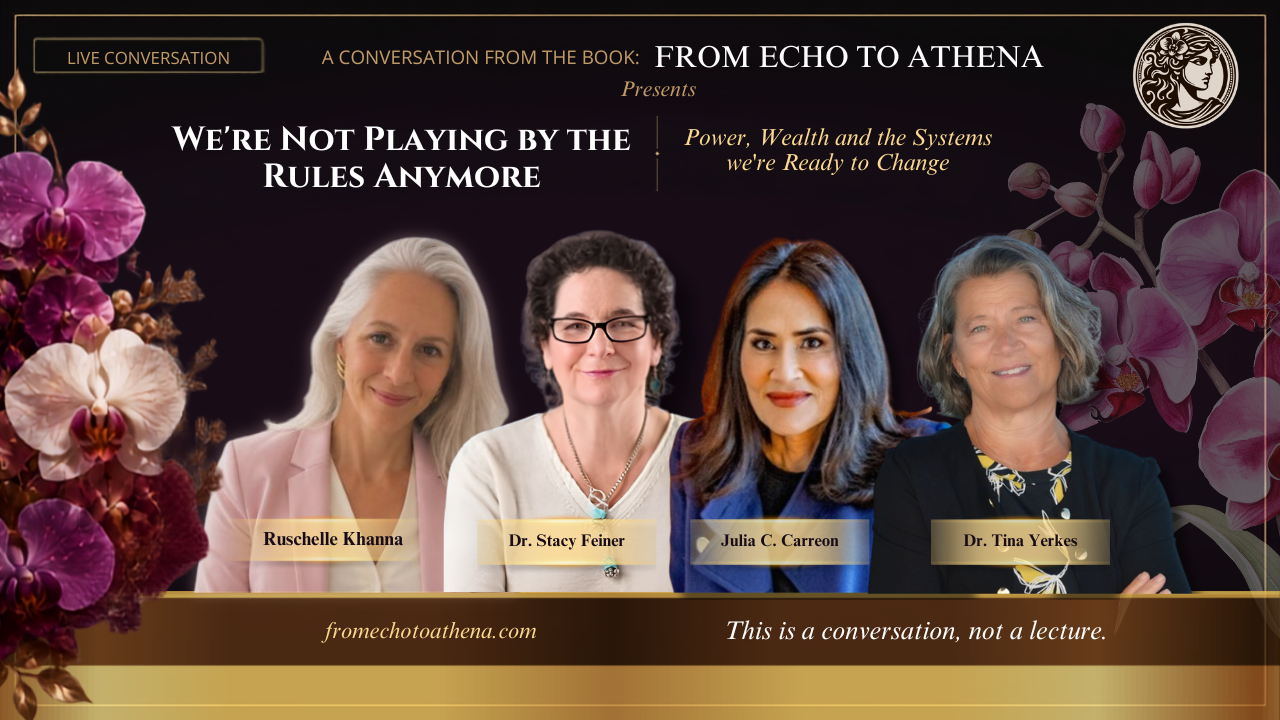
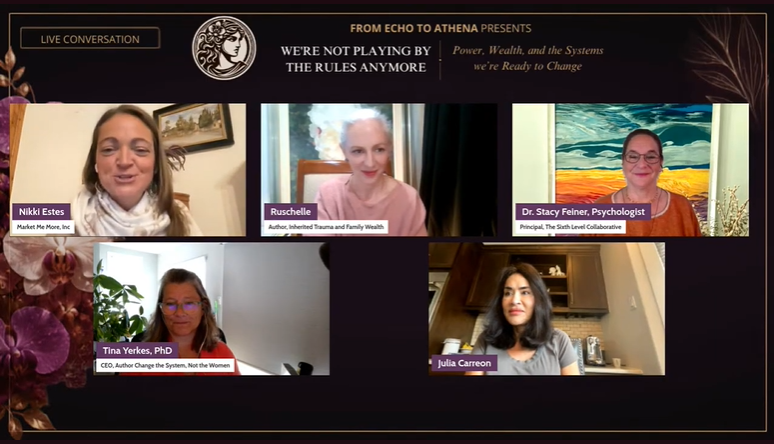
(This blog entry recaps the From Echo to Athena livestream “We’re Not Playing by the Rules Anymore: Power, Wealth and the Systems We’re Ready to Change,” streamed live on Tuesday 10 November 2026 and hosted by Nikki Estes, with Ruschelle Khanna, LCSW, Dr. Stacy Feiner, Julia C. Carreon and Dr. Tina Yerkes, PhD. Watch the full conversation)
Women are not falling behind because they ignore the rules. Many fall behind because they follow them while power moves through informal channels: sponsorship, private networks and who gets credit. Our panel argued that the fix is not a better rulebook for women. It is a redesigned system built on relational power, collective action and financial agency.
“They gave him the playbook. They gave her the rules.” Ruschelle Khanna, LCSW, curator of From Echo to Athena, opened with that line, and the hour kept returning to it.
Joining her were three fellow authors, each with a book of her own: Dr. Stacy Feiner, relational psychologist and co-author of The Sixth Level; Julia C. Carreon, financial services executive and co-author of Walking on Broken Glass; and Dr. Tina Yerkes, PhD, leadership strategist and author of Change the System, Not the Women. Nikki Estes hosted. They did not agree on everything, and that was the point.
Why do men get the playbook while women get the rules?
The formal rules are written down: work hard, deliver, wait your turn. The playbook is not. It lives in who invites whom to dinner, who speaks your name in a room you are not in, and who explains how promotions really happen.
Dr. Tina Yerkes put it plainly:
“Men are given the playbook and women are kept out of it… we get focused on women trying to squeeze into the rules. Instead we need to look at how to change these systems.”
A mentor gives you advice. A sponsor actively advocates for your advancement, often in rooms you are not in.
31% of entry-level women have a sponsor, compared with 45% of entry-level men. For every 100 men promoted to manager, 93 women are. [LeanIn.Org and McKinsey, 2025]
LeanIn.Org and McKinsey call that first promotion gap the “broken rung”. It compounds: fewer women promoted early means fewer women in line for senior roles later. In 2025, women led 55 Fortune 500 companies, a record that still amounts to 11% [Fortune, 2025].
The panel also named a double standard many women recognise: the same intensity that reads as “passion” in a man can read as “emotional” in a woman. Research backs this up. In three studies, evaluators of both genders gave angry women professionals lower status than angry men, and put women’s anger down to personality and men’s to circumstances [Brescoll and Uhlmann, 2008].
The point is not that women should feel less. It is that the rules for who may show what are not neutral. The same dynamic shows up when women leave the advisor who never saw them.
What is the Medusa complex, and how does internalized misogyny keep the system running?
Ruschelle reached for the myth at the heart of the book. In the Roman poet Ovid’s version, Medusa is assaulted by the sea god in the temple of the goddess of wisdom, and it is Medusa who is punished: her hair is turned to snakes, and Athena later carries Medusa’s image on her aegis [Ovid, Metamorphoses, n.d.]. Earlier Greek versions do not include the assault or the punishment.
Ruschelle’s reading: Medusa was punished for something she did not do, and Athena understood the architecture of power but did not use it to protect her. That is the uncomfortable mirror. Women who gain power sometimes become its gatekeepers.
Internalized misogyny means absorbing a culture’s negative beliefs about women and applying them to yourself or to other women, often without noticing.
Dr. Yerkes described women who end up “carrying the water of patriarchy”: the senior woman who tells a junior colleague to “act more like a man”, or the “mean girl” dynamic that treats another woman’s rise as a threat. Dr. Feiner added the context that makes this structural rather than personal: we are all living inside the same system. Unlearning it is part of the work, including the collective ancestral healing many women are doing across generations.
The network you share
The antidote the panel kept returning to was generosity with access. Ruschelle recalled her first meeting with From Echo to Athena contributor Dominnique Karetsos, who told her simply, “My network is your network.”
“Women have been operating in such a land of scarcity for so long that generations before us felt like they had to hoard.” Ruschelle Khanna
Scarcity taught women to guard the few seats available. Sharing a network is how you stop rationing them.
Why is care not a cost?
Traditional management logic often books care as overhead. Dr. Stacy Feiner argued the reverse. In The Sixth Level: Capitalize on the Power of Women’s Psychology for Sustainable Leadership, she and her co-authors describe a leadership model built on four core differentiators: mutuality, ingenuity, justness and intrinsic motivation [Feiner et al., 2024].
“Dominance being a rational business model is really the most blatant way of undermining shareholder value… elevating returns and yields is to invest in people and make sure that there’s collective gain.” Dr. Stacy Feiner
Dr. Feiner described women bringing a new logic into organisations, one grounded in reciprocity. Collective action is the practical form of this logic: women’s networks that move information, introductions and capital toward one another rather than competing for a single seat.
What does going strategically rogue look like?
Julia C. Carreon told the story that made the room go quiet. She spent five years on one idea: a year of research, two years writing a 161-page white paper on the future of advice, and two more years promoting it inside her firm.
Then, at an industry conference in Houston, in front of roughly 1,000 top producers, the CEO credited a young male colleague who had not been on the team. She drove two hours home to Austin in a rainstorm, crying so hard she had to pull over.
“I played the game by the rules and I did everything I was supposed to and then I didn’t get any credit for it… that is when I started blogging… if other people knew my ideas then they wouldn’t be able to be stolen so blatantly.” Julia C. Carreon
Going strategically rogue does not mean burning bridges. It means putting your ideas on the public record, under your own name, so authorship is not left to whoever holds the microphone.
The panel was honest about the tension underneath: wanting to be liked while holding opinions others do not like. Their shared answer was to stay grounded and use your authentic self as the tool, rather than performing someone else’s version of leadership.
Why is money the third door?
When a system is not working, most women see two doors: stay and change it from inside, or leave and “build a new boat”. The panel named a third: economic agency. Where your deposits sit, where capital is placed and what it funds are also decisions about which systems grow.
This is where the conversation met From Echo to Athena’s core theme. Cerulli Associates projects $124 trillion will change hands in the US through 2048 [Cerulli Associates, 2024], and $54 trillion of it will pass between spouses, more than 95 percent to women [Cerulli Associates, 2025]. As that capital moves into women’s hands, in what some call the largest matriarchal movement in history, these choices scale.
Impact investing means investing to create measurable social or environmental benefit alongside a financial return. Gender-lens investing considers gender, such as women’s access to capital, when making investment decisions.
Dr. Feiner pointed to Fortuna Bank as an example of intentional design. Founded by Lisa Berger and Ilaria Rawlins, it opened in Grandview Heights, near Columbus, as Ohio’s first majority women-owned bank, raising $20.76 million from 350 shareholders, about 75 percent of them women [Columbus CEO, 2025]. Banks like this are rare: fewer than 20 of the nearly 4,800 US banks are women-owned [Denison Magazine, 2024].
If you think of money as a form of voice, a giving plan is another place where intention turns into structure.

Five actions for the next 30 days
The panel closed with one question for every speaker: what can every woman do in the next 30 days? Their answers:
- Learn where your money sits. Find out which institutions hold your deposits and investments and what they fund. Explore women-owned and impact-focused options as part of that education. This is not a recommendation to move money; speak with a qualified professional first.
- Extend your network. Make one introduction this month that you would once have kept to yourself. My network is your network.
- Interrupt public misogyny. When a woman is dismissed in a meeting or attacked online, say something, publicly and specifically.
- Publish your ideas under your name. Put one piece of your thinking on the record: a post, an article, a memo with your byline.
- Ask structural questions. In your next meeting, ask about pay equity, how resources are allocated or how promotions are decided.
From Echo to Athena
Echo repeats what she has been given. Athena acts from her own wisdom. The move between them is not about becoming harder or louder. It is about relational authority, shared access and financial sovereignty: writing a playbook others can read. For a practical place to start, see how to break free from the family wealth labyrinth, and for our first livestream, The Wealth Transfer Starts With Us.
Which unwritten rule are you ready to stop following today, so you can start writing your own playbook tomorrow?
Get the book
Same title. Different warehouse.
If you are ordering from the United Kingdom or Europe, use the UK button. The US page will not ship print to most European addresses.
Get Bonus Gifts: Write Your Afterword
Apply to join the next cohort: a 6-week virtual program culminating in an exclusive retreat and travel experience with authors Deborah Delaney and Ruschelle Khanna (me).
Sources
- From Echo to Athena. “We’re Not Playing by the Rules Anymore: Power, Wealth and the Systems We’re Ready to Change.” YouTube livestream, 10 November 2026. youtube.com. The event was recapped in this post.
- LeanIn.Org and McKinsey & Company. Women in the Workplace 2025. Supports: sponsorship gap (31% vs 45%); broken rung (93 per 100).
- Brescoll, V. L. and Uhlmann, E. L. “Can an Angry Woman Get Ahead?” Psychological Science 19(3), 2008. Supports: anger and status double standard.
- Fortune. “Women run 11% of companies on 2025 Fortune 500.” 2 June 2025. Supports: 55 women CEOs.
- Ovid. Metamorphoses, Book 4, trans. A. S. Kline. University of Virginia. Supports: Ovid’s Medusa story.
- Feiner, S., Andreasson, R. W., Overbeke, K. and Harris, J. The Sixth Level. Amplify Publishing, 2024. Supports: four differentiators.
- Cerulli Associates. “Cerulli Anticipates $124 Trillion in Wealth Will Transfer Through 2048.” 5 December 2024.
- Cerulli Associates. “$54 Trillion Will Transfer to Widows Through 2048; More Than 95% Will Go to Women.” 22 January 2025.
- Columbus CEO. “Inspiring Women: Lisa Berger and Ilaria Rawlins Forge a New Banking Model.” 21 April 2025. Supports: Fortuna Bank facts.
- Denison Magazine. “Banking on her vision.” 2024. Supports: fewer than 20 women-owned US banks.
- Speaker bios: stacyfeiner.com; tinayerkes.com; juliacarreon.com; dominniquekaretsos.com.
Meet the Author
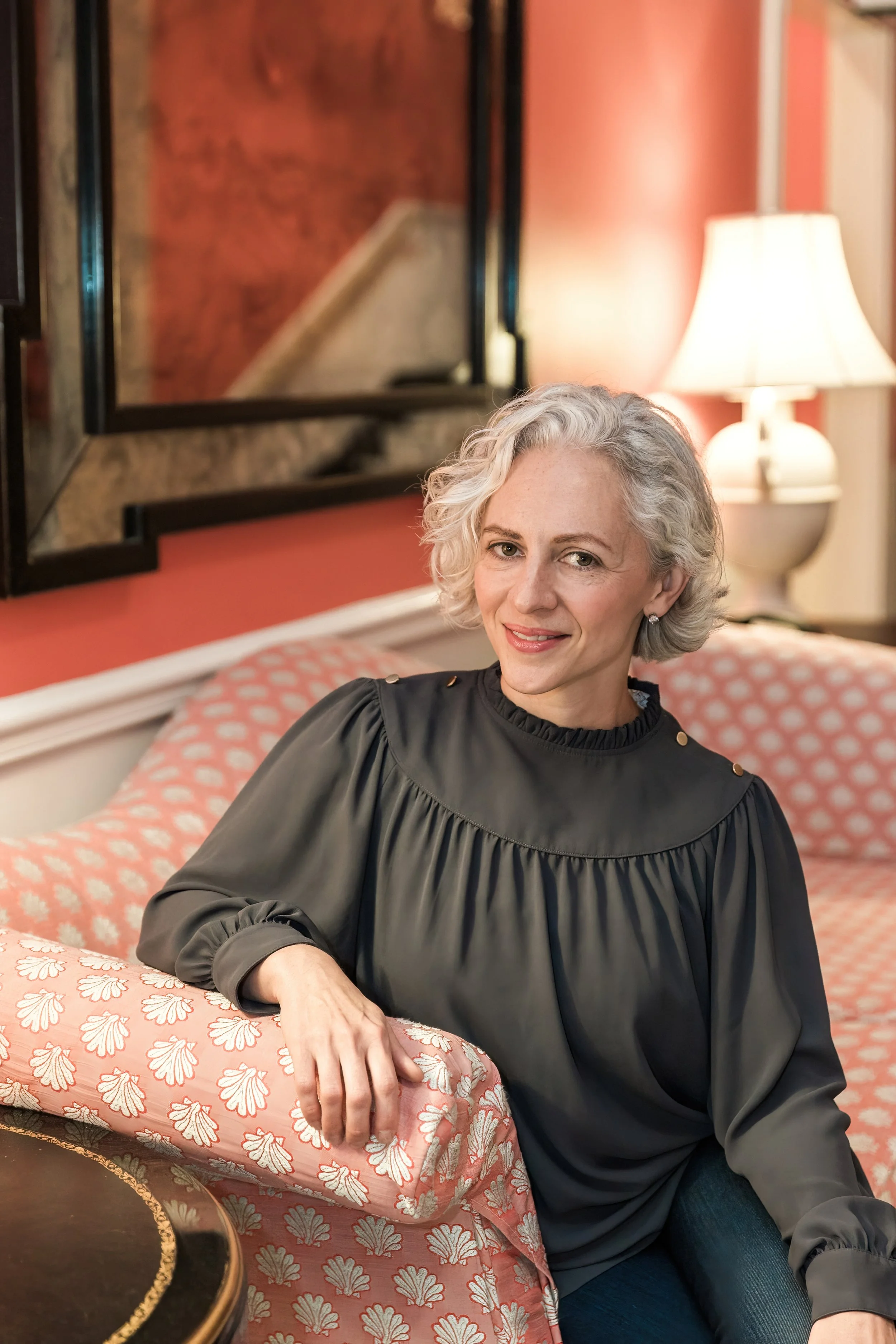
Ruschelle Khanna, LCSW, is the lead curator and guiding voice of From Echo to Athena. Six weeks after publication, the book earned #1 New Release in Wealth Management and Top 100 rankings in Women & Business and Wealth Management on Amazon last September 16, 2026.
The work continues in a growing number of rooms, in person and virtually. She is the guide. The work is yours.
FAQs
What is the difference between mentorship and sponsorship?
A mentor offers advice. A sponsor actively advocates for your advancement. Women in the Workplace 2025 found 31% of entry-level women have a sponsor, compared with 45% of entry-level men [LeanIn.Org and McKinsey, 2025].
What is the “broken rung”?
The promotion gap at the first step up to manager. In 2025, 93 women were promoted to manager for every 100 men [LeanIn.Org and McKinsey, 2025].
What is the Medusa complex?
The panel’s name for how women who gain power can end up enforcing the rules that harmed them. It draws on Ovid’s version of the myth, in which Medusa is punished for an assault she suffered.
What are the four differentiators in The Sixth Level?
Mutuality, ingenuity, justness and intrinsic motivation, as described by Dr. Stacy Feiner and her co-authors [Feiner et al., 2024].
What does “money is the third door” mean?
Beyond staying to change a system or leaving to build a new one, women can use where their deposits, investments and giving go as another lever. This is education, not financial advice.